Last Updated on August 5, 2026 by Laura
If you follow this blog, you know I focus on getting most of your nutrition from food.
Building your plate with a variety of fruits, vegetables, grains, and protein like Greek yogurt, chicken, fish, eggs, beans, or cottage cheese is usually more than enough to meet your protein and nutritional needs.
But as we all know, life doesn’t always cooperate. There are times when a supplement may be needed to fill in the gaps.
Maybe your appetite isn’t what it used to be, and getting enough protein before noon feels like a stretch.
Maybe you’ve been tracking your protein intake, and you’re consistently falling short no matter how hard you try.
Or maybe you’re recovering from an illness or surgery, and eating a full meal or many small meals just isn’t working right now.
If any of that sounds familiar, a protein supplement might be helpful, and that’s just fine.
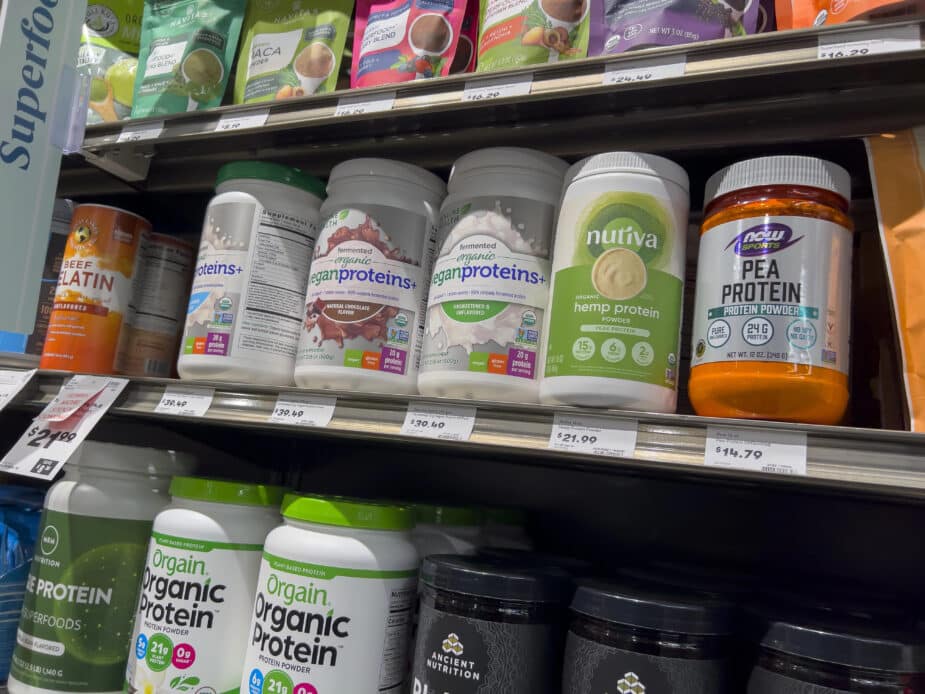
The problem many of us run into, though, is knowing what to look for. When you look at that shelf full of supplements and powders in the grocery store, or open your computer to search, you’re immediately hit with dozens of options, promising bold claims, and very little guidance, especially for women like us.
That’s what this post is for. Hi, I’m Laura, a registered dietitian nutritionist. This post focuses on what to look for in a protein supplement without the hype. Just a practical guide to help you feel confident choosing a protein supplement that actually makes sense for you.
(New here? Start with Are Protein Supplements Good for Health? and Protein for Healthy Aging for the full picture.)
Please note this post may contain affiliate links. As an Amazon Associate, I earn from qualified purchases
Table of Contents
HOW MUCH PROTEIN SHOULD A SUPPLEMENT PROVIDE?
The first number you’ll notice on any protein supplement label is the grams of protein per serving. So what’s a reasonable amount?
For most of us, a supplement providing 15 to 30 grams per serving hits the sweet spot. That’s enough to meaningfully support muscle maintenance without going overboard.
Here’s what to watch for at either end of the spectrum:
Too little (under 15 grams): Some products — especially those blended into snack bars or “light” drinks — don’t provide enough to move the needle. You’d need multiple servings to get a real benefit, which gets expensive fast.
Too much (over 40 grams): More isn’t better here. Research suggests that your body can only use so much protein at one time for muscle building, and the benefit plateaus well before those mega-doses you’ll see on some products. Extra protein beyond what your body needs is just processed like any other calorie.
It’s also worth glancing at the calorie count. A supplement containing 25 grams of protein, at around 120–150 calories, is reasonable. If you’re seeing 300+ calories per serving, you may be looking at a meal replacement or weight-gain product — which is a different thing entirely.
One more important note: I’m a Registered Dietitian, but I’m not your dietitian. Individual protein needs vary widely depending on your weight, activity level, and health conditions. If you’re unsure what your daily protein goal should be, it’s worth a conversation with your own RD or healthcare provider before you start shopping.
TYPES OF PROTEIN: WHAT’S THE DIFFERENCE?
Walk down the supplement aisle, and you’ll see all kinds of protein sources on labels. Whey, pea, collagen, soy, hemp, and more. It can feel overwhelming. Here’s a simple breakdown of what you’ll most commonly find and what is most important for those of us in our 50s and 60s.
Whey Protein
Whey is derived from dairy and is one of the most well-researched protein supplements. It’s a complete protein, meaning it contains all nine essential amino acids your body needs. It’s also absorbed fairly quickly, which is helpful for muscle recovery after exercise.
There are two main types of whey found in protein supplements:
Whey Isolate: This is the better choice if you are lactose intolerant or lactose-sensitive. It undergoes additional processing that removes most of the lactose.
Whey concentrate: This type retains more of the natural dairy components and is often less expensive, but it may cause digestive discomfort if you’re lactose intolerant.
Plant-Based Proteins
Pea, hemp, soy, and brown rice are the most common plant-based options. A few things worth knowing:
- Pea protein is well-tolerated by most people and easy to digest. It contains all nine essential amino acids. It is low in one amino acid, called methionine, which makes it not quite as high-quality as whey or soy protein.
- Soy protein is a complete protein and one of the most studied plant-based options. It is easily digested by most people, but soy is one of the top food allergens, so anyone allergic should avoid it.
- Hemp and rice proteins are less complete on their own. They both contain the amino acid methionine, which is why you’ll often see them blended or combined with pea protein.
If you’re going plant-based, look for a blend of two or more sources rather than a single source. This helps ensure you’re getting a more complete amino acid profile.
Collagen Protein
I want to spend a moment here because collagen supplements are heavily marketed to women our age, and they deserve a closer look. Collagen is not a complete protein. It’s missing an essential amino acid called tryptophan, which means it can’t support muscle building the way whey or a good plant-based blend can.
That doesn’t mean collagen has no value. There’s some interesting research around joint health and skin elasticity, but it shouldn’t be your primary protein supplement.
If you are interested in learning more about collagen supplements and why I think they are helpful for some people, check out my post on Collagen Supplements After 50.
READING THE INGREDIENT LIST
Here’s something I tell people all the time: flip the container over and read the ingredient list before you look at anything else on the label. The front of the package is marketing and a lot of fluff to convince you it is the best product for you. The back of the package – that is the truth.
What you want to see:
A short, recognizable ingredient list is always a good sign. The protein source should be listed first. Whey protein isolate, pea protein, etc., and ideally, the list is relatively short.
Keep in mind that some ingredients contain multiple sub-ingredients. So you may see a “protein blend” that lists 2-4 types of protein.
Another example might be chocolate powder. This could include ingredients such as cocoa butter, sugar, and vanilla.
What to watch out for:
- Added sugars: A small amount isn’t a dealbreaker, but some supplements — especially flavored ones — sneak in quite a bit. Look at the nutrition label and aim for no more than 5–6 grams of added sugar per serving.
- Artificial sweeteners: Sucralose, acesulfame potassium, and others are common in “sugar-free” products. They’re generally considered safe, but some people find they cause digestive issues or don’t love the aftertaste. Good to know before you commit to a big container.
- Proprietary blends: This is a red flag to watch out for. Some products list a “proprietary blend” of ingredients without telling you how much of each is included. That makes it impossible to know if you’re actually getting a meaningful amount of anything.
- Sodium: Often overlooked, but it can add up — especially if you’re watching your blood pressure. Check the label and compare a few options.
A supplement with a straightforward ingredient list is almost always a better bet than one with a paragraph of additives, regardless of what the front of the package promises.
THIRD-PARTY TESTING AND QUALITY CERTIFICATIONS
Here’s something that surprises a lot of people: protein supplements — like most dietary supplements — are not strictly regulated by the FDA the way medications are. That means companies don’t have to prove their products are safe or effective before putting them on store shelves.
That’s not a reason to panic, but it is a reason to be a smart shopper.
The best way to protect yourself is to look for products that have been tested by an independent, third-party organization. These groups test supplements to verify that what’s on the label is actually in the product and that it doesn’t contain anything harmful.
Here are the certifications I look for:
- USP Verified – The U.S. Pharmacopeia has been setting quality standards for supplements for over 200 years. A solid, trustworthy seal.
- ConsumerLab – An independent organization that regularly tests supplements and publishes results. You can check their website before you buy.
- NSF Certified for Sport – One of the most rigorous certifications available. Originally designed for athletes, but a great quality signal for anyone.
- Informed Sport – Similar to NSF, tests for banned substances and label accuracy.
You won’t find these seals on every product, and that doesn’t automatically mean a supplement isn’t good or pure. But when you do see one of these logos, it’s a good sign that the company takes quality seriously and takes the extra step to ensure it.
One more tip: Buying from established, reputable brands that have been around for a while is generally safer than grabbing the cheapest option or the newest product making the boldest claims.
DIGESTIBILITY AND TOLERANCE
Finding a protein supplement that works for you nutritionally is only half the battle. It also needs to agree with your digestive system — because the best supplement in the world is one you’ll actually use.
A few things to keep in mind:
Lactose sensitivity and whey: If dairy tends to bother you, whey concentrate may cause bloating or discomfort. Whey isolate is a better option since most of the lactose has been removed. If you’re more significantly lactose intolerant, a plant-based option might suit you better.
Plant proteins and bloating: Some people find pea or other plant-based proteins cause a bit of gas or bloating, especially when they’re first starting out. This often improves over time as your body adjusts. Some products add digestive enzymes to help with this — worth looking for if you know your digestion is sensitive.
Sugar Alcohols and digestive issues: Sugar alcohols are carbohydrates but have few calories. They are often used as sugar substitutes, including xylitol, erythritol, sorbitol, and manitol, which may cause gas and bloating in some people. You may want to avoid those or try a little and see how your system tolerates them.
Start small: Before you commit to a large container of anything, try to find a single-serving sample or a smaller size first. Many stores carry individual packets, or you can often find them at supplement stores to try before you buy. Your stomach will tell you a lot in the first week or two.
A note on fiber: Some protein supplements, especially those marketed as meal replacements, include fiber. A little extra fiber isn’t a bad thing, but if you’re not used to it, jumping in too fast can cause discomfort. Again, starting with a smaller amount and working up is always a good idea.
The bottom line: pay attention to how your body responds, and don’t feel like you have to stick with something that doesn’t feel good just because it checks every other box.
TASTE, TEXTURE, AND PRACTICALITY
So let’s start with the most important quality in my book, taste. Just like anything else you eat, if it tastes terrible, you’re not going to use it. And a protein supplement that sits in your pantry untouched isn’t helping anyone.
Taste and texture are completely legitimate factors to consider in your decision, and don’t let anyone make you feel otherwise.
A few things to think about:
Flavor: Chocolate and vanilla are the most common, and the quality varies wildly between brands. Unflavored options exist, too, and can be a great choice if you plan to mix your supplement into smoothies, oatmeal, or yogurt, where other flavors will do the heavy lifting.
Mixability: Some powders mix easily into water or milk with just a spoon. Others clump, separate, or leave a gritty texture no matter what you do. If easy preparation matters to you, look for reviews that specifically mention mixability, or try a sample first.
Versatility: Think about how you actually plan to use it. If you want something you can stir into your morning yogurt or add to a recipe, a neutral-flavored powder is probably your best bet. If you want a quick post-walk shake, something that mixes easily in a shaker cup makes more sense.
Convenience: The best supplement is the one that fits seamlessly into your routine. A product that requires a blender, three add-ins, and ten minutes of preparation isn’t going to become a habit. Keep it simple.
This is also where trying before committing really pays off. A sample packet costs almost nothing compared to a large container of something you end up not enjoying.
PRICE: WHAT’S REASONABLE?
Protein supplements range from surprisingly affordable to eye-wateringly expensive, and price doesn’t always reflect quality. Here’s how to think about it without getting overwhelmed.
Look at cost per serving, not cost per container. A $60 container sounds steep until you realize it has 40 servings — that’s $1.50 per serving, which is quite reasonable. Meanwhile, a $30 container with only 15 servings costs you twice as much per use. Flip the container over, check the serving count, and do the quick math.
What’s a reasonable range? Generally speaking, a high-quality protein supplement will run you between $1.50 and $2.50 per serving. You can find decent options below that, and you can certainly spend more — but once you get above that range, you’re often paying for fancy packaging, celebrity endorsements, or aggressive marketing rather than a better product.
Where you buy matters too. Big-box stores and warehouse clubs like Costco, Sam’s or BJs can be great places to find quality options at lower prices. Online retailers are worth comparing, but stick to purchasing directly from the brand’s website or a reputable retailer to avoid counterfeit products — yes, that’s a real thing with supplements. Supplement-specific stores can be helpful for sampling and getting questions answered, but prices tend to be higher.
One more tip: Hold off on buying the giant economy size until you know you like the product and tolerate it well. Start small, try it for a couple of weeks, and then stock up if it works for you.
RED FLAGS TO LOOK FOR
We’ve talked a lot about what to look for — let’s take a quick look at what should give you pause.
Outrageous claims. If a supplement promises to burn fat while you sleep, reverse aging, or deliver dramatic results in 7 days, put it back on the shelf. No supplement can do any of those things, and bold claims like these are a reliable sign that marketing is doing the heavy lifting.
“Clinically proven” without any context. This phrase gets thrown around constantly in the supplement world, and it means almost nothing without knowing what was actually studied, how large the study was, and who funded it. One small, industry-funded study does not “clinically prove” anything.
Heavy influencer or celebrity marketing. This isn’t automatically a dealbreaker, but it’s worth noting that a big marketing budget often means a higher price tag — and the celebrity on the label had nothing to do with formulating the product.
Proprietary blends that hide amounts. I mentioned this in the ingredient section, but it’s worth repeating here. If a label lists a “proprietary blend” without disclosing how much of each ingredient is included, you have no way of knowing whether you’re getting an effective dose of anything.
Anything marketed as a meal replacement is dressed up as protein. Meal replacements have their place, but they’re a different product with a different purpose. If you’re looking for a protein supplement, make sure that’s actually what you’re buying.
A price that seems too good to be true. Very cheap supplements from unknown brands — especially online — may not contain what they claim. Third-party testing certification matters even more when the price seems suspiciously low.
PUTTING IT ALL TOGETHER
Choosing a protein supplement doesn’t have to be complicated — though the supplement industry does its best to make it feel that way!
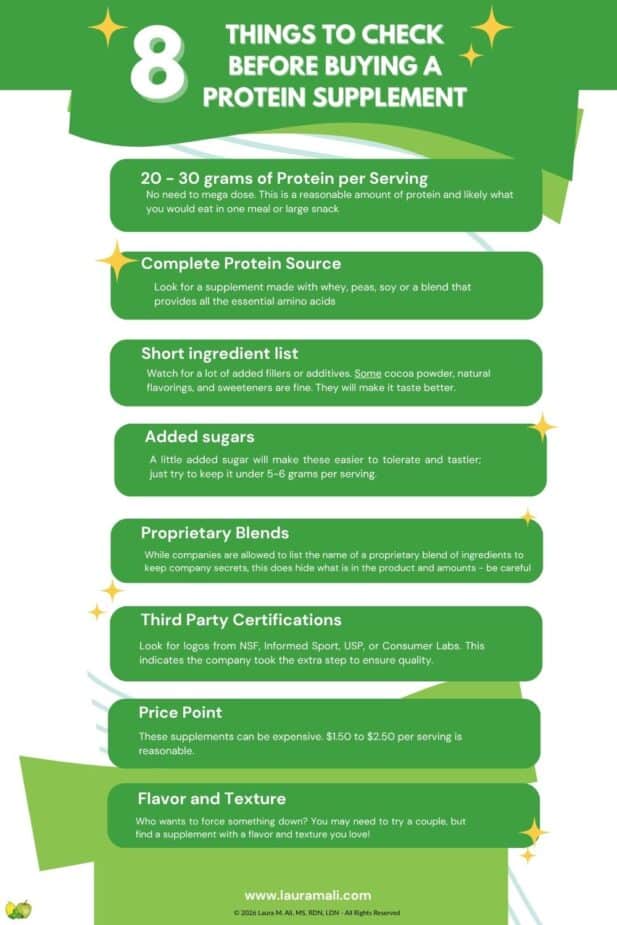
The good news is that once you know what to look for, you can cut through the noise pretty quickly. Focus on a supplement that provides 20–30 grams of protein per serving from a quality source, has a short and recognizable ingredient list, and carries a third-party testing certification if possible. Make sure it’s something you can actually digest, that fits your routine, and — let’s be real — that you actually enjoy using.
Here’s a quick checklist of 8 things to look for. You can screenshot this list or Pin the image for the next time you’re standing in the supplement aisle:
A couple of brands and products I like:
Drink Wholesome (affiliate link) – these are easy-to-digest, minimal ingredient protein supplements that are available in both animal and plant-based protein sources. I enjoy both the chocolate and the vanilla egg white powders, as well as the almond powder. You can order a sample pack to try a variety to see which you prefer.
Orgain Protein: Orgain offers a variety of protein drinks, powders, and bars. I prefer the premade drinks. You can find many of their products in your local grocery stores.
And as always — I’m a Registered Dietitian, but I’m not your dietitian. If you have specific health conditions, take medications, or aren’t sure where to start with your protein goals, please loop in your own healthcare provider or RD before adding a new supplement to your routine.
Have questions about protein supplements? Drop them in the comments below — I’d love to hear what you’re finding in the supplement aisle and what’s working for you!
(Looking for more on protein? Check out “Protein for Healthy Aging” and “Are Protein Supplements Good for Health?” for the full picture. And keep an eye out for my upcoming post all about collagen — because that one deserves its own conversation!)